GHRH-receptor agonism
The peptide activates pituitary GHRH receptors involved in growth-hormone signalling.

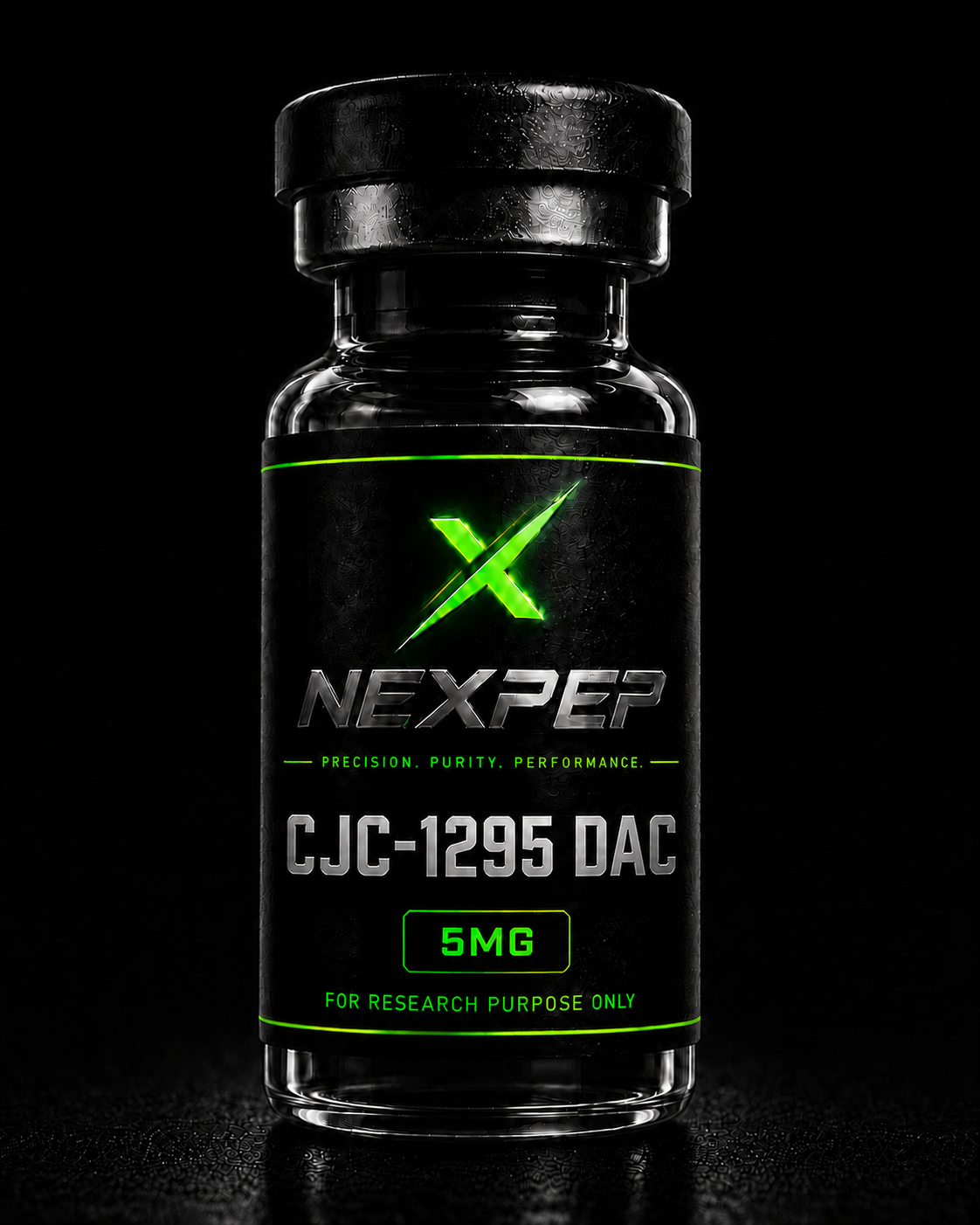
Research profile
Long-acting GHRH-analogue research peptide
CJC-1295 DAC is a growth-hormone-releasing-hormone analogue modified with a drug-affinity complex designed to bind circulating albumin. It is distinct from CJC-1295 no-DAC and modified GRF presentations.
Scientific context
Controlled research uses CJC-1295 DAC to examine extended GHRH-receptor stimulation, growth-hormone pulse dynamics and downstream IGF-1 responses. The DAC modification materially changes exposure duration and study design.
Mechanism map
The peptide activates pituitary GHRH receptors involved in growth-hormone signalling.
The DAC moiety forms a longer-lived association with albumin, extending exposure relative to no-DAC material.
Research measures growth-hormone and IGF-1 dynamics across a longer sampling window.
Study design
These are experimental design concepts—not recommendations for human use, co-administration or dosing.
Directly tests the experimental effect of extended exposure.
Do not treat DAC and no-DAC products as interchangeable.Establishes baseline endocrine and assay variability.
Match the extended sampling schedule used for the DAC arm.CJC-1295 DAC alone provides the clearest formulation-level signal.
Avoid secretagogue combinations in the primary comparison.Interpretation controls
Evidence trail