KISS1 receptor binding
Kisspeptin-10 binds the G-protein-coupled KISS1 receptor on relevant neuroendocrine cells.

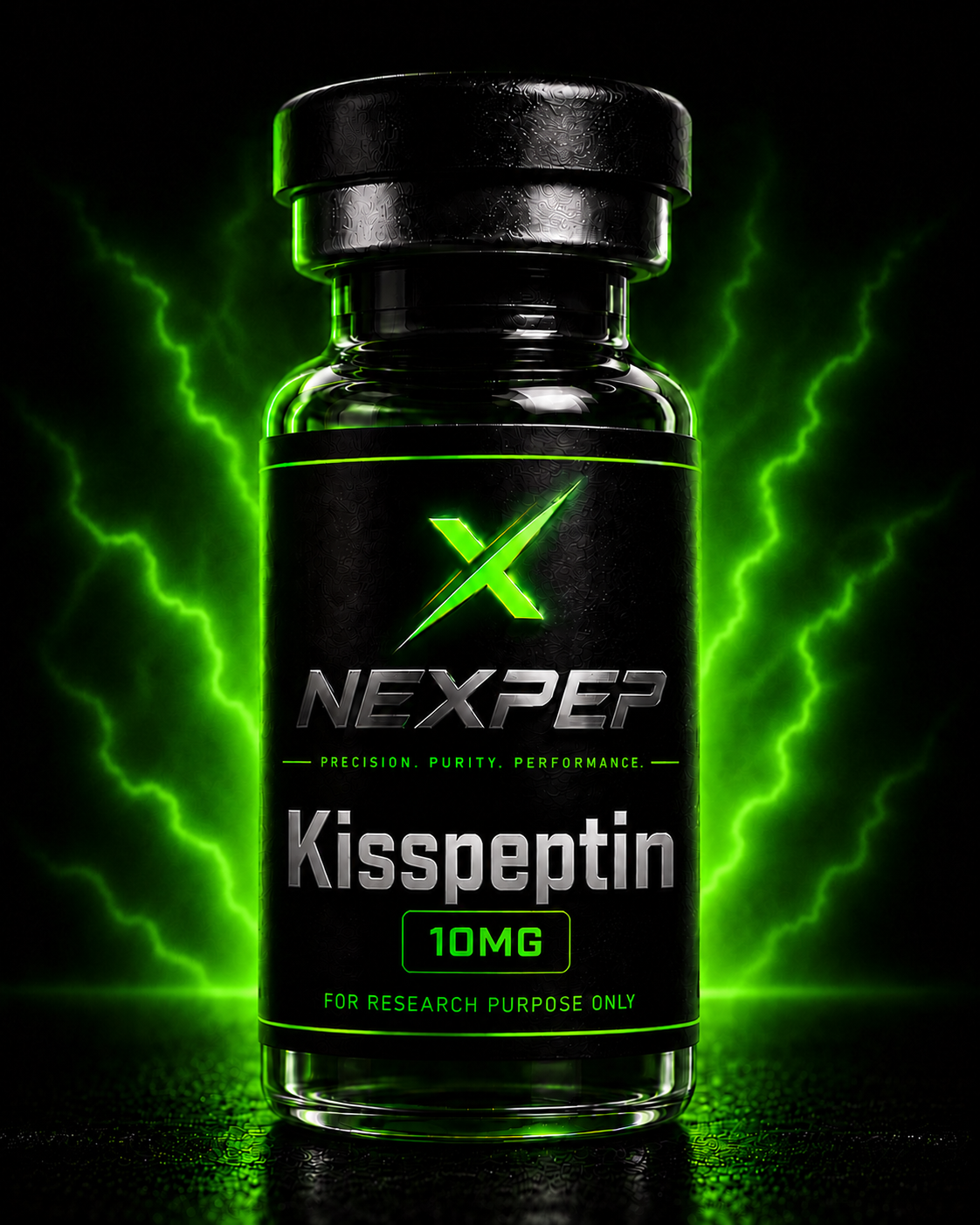
Research profile
KISS1-receptor agonist research peptide
Kisspeptin is a KISS1-derived signalling peptide and a potent upstream regulator of the hypothalamic reproductive axis. Kisspeptin-10 is the shortest commonly studied bioactive fragment and activates the KISS1 receptor, also known as GPR54.
Scientific context
Controlled research uses kisspeptin to investigate gonadotropin-releasing hormone signalling, luteinising-hormone and follicle-stimulating-hormone responses, reproductive neuroendocrinology and hormone-sensitive feedback loops. Responses depend strongly on isoform, exposure pattern and model context.
Mechanism map
Kisspeptin-10 binds the G-protein-coupled KISS1 receptor on relevant neuroendocrine cells.
Receptor signalling activates upstream neurons that regulate pulsatile gonadotropin-releasing hormone output.
GnRH signalling is reflected in luteinising-hormone and follicle-stimulating-hormone dynamics, providing measurable experimental endpoints.
Study design
These are experimental design concepts—not recommendations for human use, co-administration or dosing.
Provides a separate growth-hormone-axis arm for distinguishing reproductive-axis signalling from broader pituitary responses.
Use separate comparator arms; this does not establish compatibility or support co-administration.Offers an orthogonal cellular-metabolism control where endocrine responses and energy-state measurements are collected together.
Preserve single-variable controls and predefine the primary endpoint.Kisspeptin alone gives the clearest attribution of KISS1-receptor and gonadotropin responses.
Match vehicle, sampling time and exposure pattern across groups.Interpretation controls
Evidence trail