GHRH-receptor pathway
The CJC-1295 component is designed to activate pituitary GHRH receptors and support endogenous growth-hormone pulse signalling.

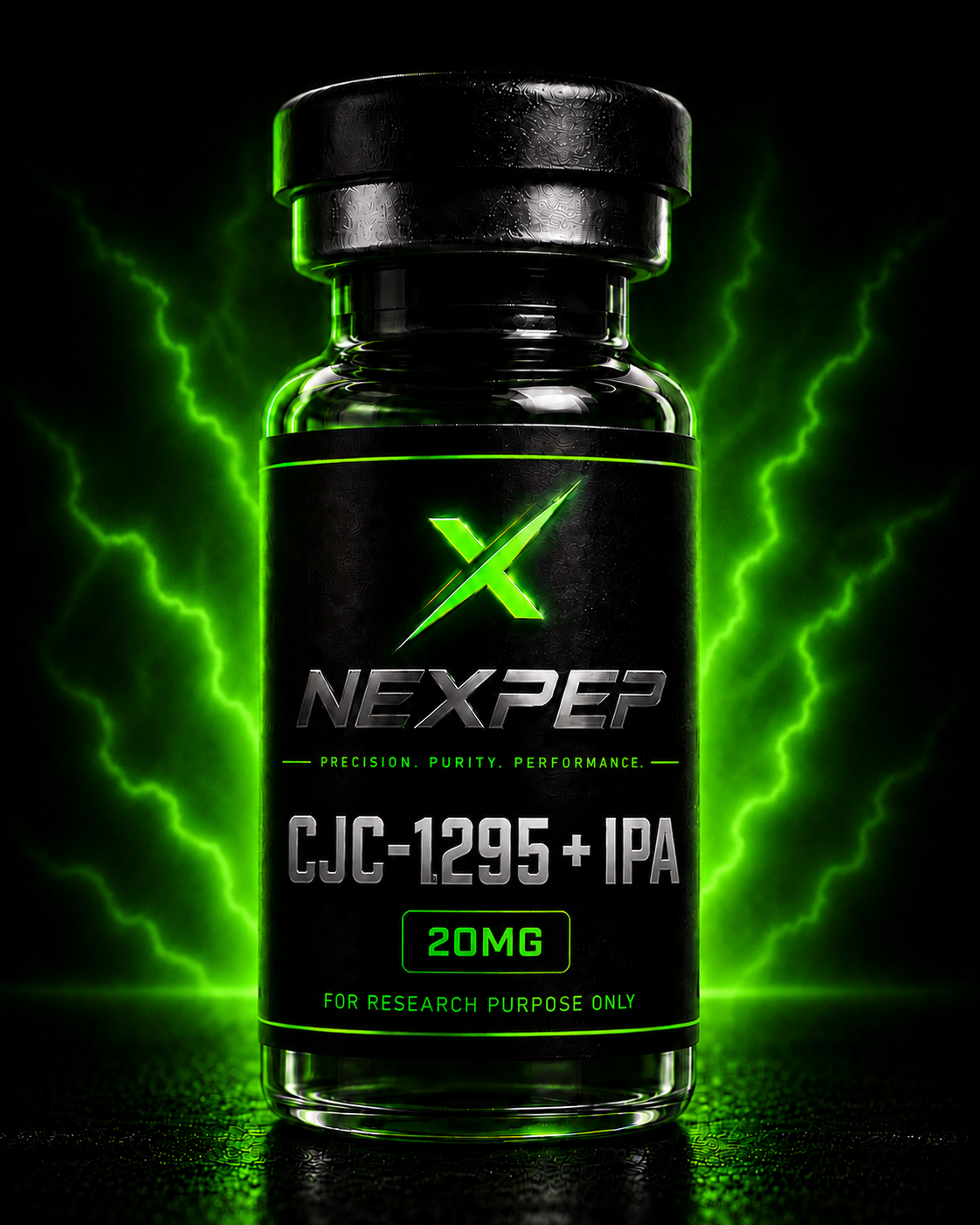
Research profile
Dual growth-hormone secretagogue research complex
This complex combines a CJC-1295-class growth-hormone-releasing-hormone analogue with ipamorelin, a selective growth-hormone secretagogue. The components address different receptor pathways converging on pulsatile growth-hormone release.
Scientific context
Research applications examine growth-hormone pulse dynamics, IGF-1 response, receptor-pathway interaction and the difference between GHRH-receptor and ghrelin-receptor signalling. Interpretation requires exact confirmation of whether the CJC material is DAC-modified or no-DAC because their pharmacokinetics differ substantially.
Mechanism map
The CJC-1295 component is designed to activate pituitary GHRH receptors and support endogenous growth-hormone pulse signalling.
Ipamorelin acts through the ghrelin or growth-hormone-secretagogue receptor, providing a mechanistically distinct secretagogue signal.
The two inputs converge on somatotroph output, making component-only controls essential for identifying interaction effects.
Study design
These are experimental design concepts—not recommendations for human use, co-administration or dosing.
Isolates the contribution of GHRH-receptor signalling to the combined response.
The comparator must match the blend's confirmed DAC or no-DAC identity.Identifies the ghrelin-receptor contribution and helps test additivity against the complete blend.
Use equivalent assay conditions and a predefined interaction model.The blend alone is the cleanest formulation-level condition before introducing unrelated compounds.
Additional stacks would further limit component attribution.Interpretation controls
Evidence trail