BPC-157 pathway
Preclinical work reports modulation of VEGF-associated angiogenesis and nitric-oxide-related signalling during tendon and muscle repair.

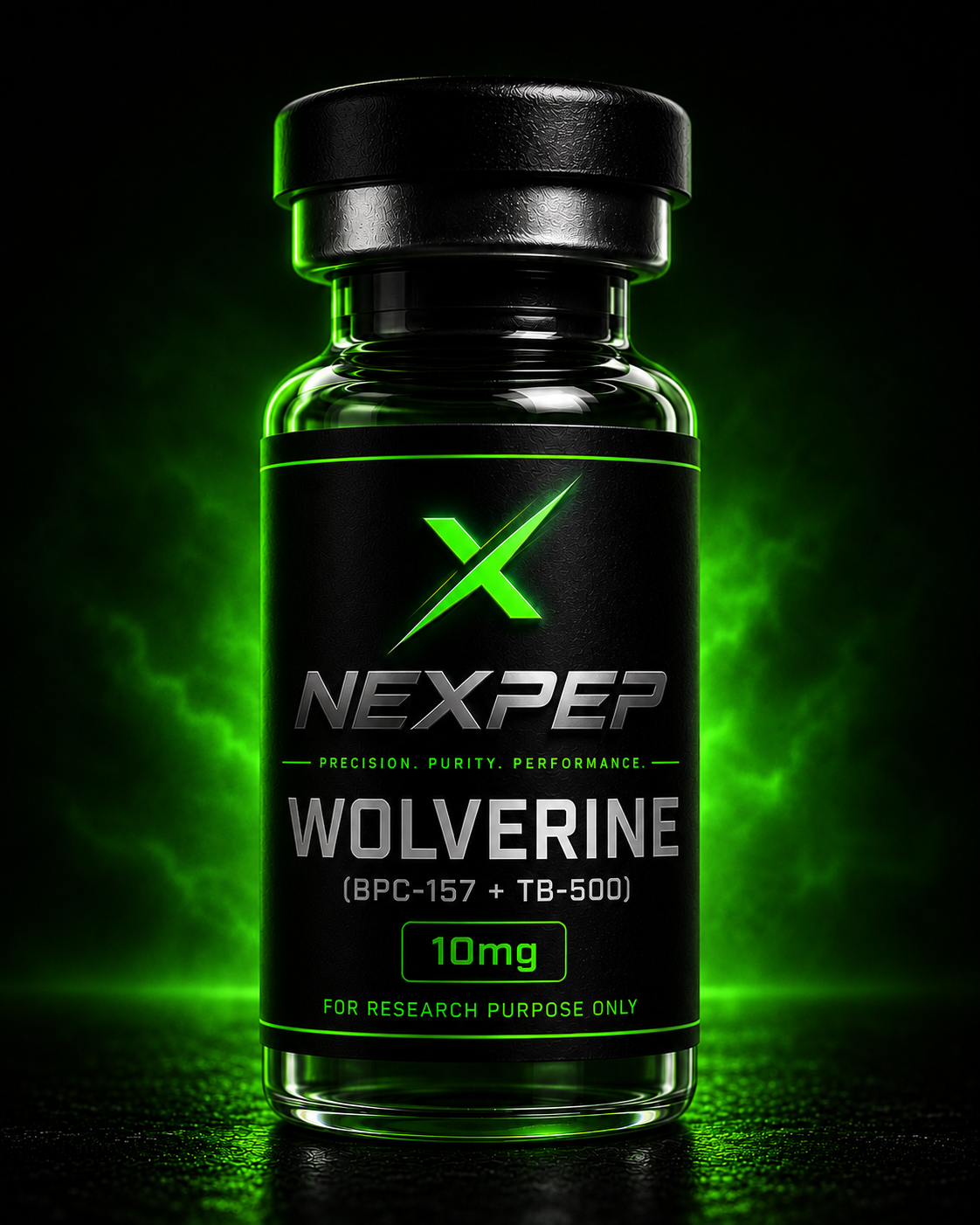
Research profile
BPC-157 + TB-500 research complex
Wolverine combines BPC-157 with TB-500-related material in one research presentation. The blend is designed for controlled investigation of two distinct but overlapping repair-associated pathways: vascular signalling and actin-dependent cell movement.
Scientific context
BPC-157 has been studied mainly in animal models for angiogenesis, nitric-oxide signalling and muscle/tendon repair. Thymosin beta-4 research focuses on G-actin sequestration, endothelial-cell migration and angiogenesis. These findings are preclinical and do not establish human efficacy or safety.
Mechanism map
Preclinical work reports modulation of VEGF-associated angiogenesis and nitric-oxide-related signalling during tendon and muscle repair.
TB-500 is associated with a thymosin beta-4 fragment; parent-peptide research links actin binding with cell migration and angiogenic activity.
Overlapping repair endpoints may produce additive or confounded signals, so component controls are essential.
Study design
These are experimental design concepts—not recommendations for human use, co-administration or dosing.
Adds copper-dependent matrix and collagen endpoints to a broader preclinical repair model.
Because angiogenesis overlaps, include BPC-157, TB-500 and GHK-Cu single-agent controls.Introduces redox and cellular-energy measurements alongside migration or remodelling endpoints.
Confirm assay compatibility and preserve separate arms for interpretation.The Wolverine complex already contains two research components, making an unstacked arm the strongest starting design.
Avoid GLOW unless its batch composition has been confirmed not to duplicate constituents.Interpretation controls
Evidence trail